He also had another problem, because in 1964 no decision had yet been made on the patents he had applied for with his Z3 computer. In 1967 a decision was made by the German patent court and Konrad Zuse lost his 26 year fight about the invention of the Z3 with all its new features [ROJA98]. Konrad Zuse's early computers consisted of well known structural components, namely relays. Using these relays he constructed the Z3 computer, but the (patent) justices could not follow the arguments that well known components could be combined to form a really new machine. When Konrad Zuse left the Zuse KG in 1969 he was 59 years old.
We will now discuss some of Konrad Zuse's major activities following 1964/69, which were his autobiography, his (oil) paintings, the computing universe, the reconstruction of the Z1 (as discussed earlier in this article), and the Helix-Tower. We will not consider his works on self-reproducing systems and Petri-Nets, because from my view his contributions to both of these fields were not particularly significant. Also, we will not discuss the parallel computer, which he designed (but didn't build) in 1958, because this would be beyond the scope of this article. My father received many awards for his work on computers, some of which we would like to mention here.
Some of Konrad Zuse's Awards
In 1956, Konrad Zuse received the Dr.-Ing. e.h. for his achievements in the area of computing from the Technical University of Berlin. In 1965, he was given the Werner von Siemens Award in Germany, which is the most prestigious technical award in Germany. In 1965 Konrad Zuse received the Harry Goode Memorial Award together with Stibitz in Las Vegas (Stibitz was also a pioneer of binary floating point arithmetic around 1944/45).
Amongst many other awards, Konrad Zuse was presented with a dozen honorary Doctorships (including those from Iceland, Switzerland, and East Germany (Dresden)). two honorary Professorships (from Göttingen in Germany and Stettin in Poland). Furthermore, about twenty streets in different cities are named Konrad Zuse Straße, two schools (in Hünfeld and Hoyerswerda) carry his name and he was made an honorary citizen in both Hünfeld and Hoyerswerda. There is also the Konrad Zuse Zentrum für Informationstechnik (Center for Scientific Computing) in Berlin, and in September 1999 he will be made a fellow of the Computer History Center in Mountain View, California, USA.
Autobiography
After leaving the Zuse KG, Konrad Zuse concentrated on his autobiography. As late as 1970, the Publisher Moderne Industrie, published the first edition of his autobiography. And, as late as 1983, the Springer publisher took over the autobiography. In 1993, the Springer Publisher offered an English translation of the autobiography [ZUSE93]. Unfortunately, it took a long time for scientists to accept and recognize Konrad Zuse's work. After 1975 he found friends who supported his unique contributions, which later led to the reconstruction of the Z1 in 1986.
Computing Universe
In [ZUSE69] Konrad Zuse postulated that the universe consists of millions of parallel working micro-computers. However, it would be beyond the scope of this article to take a deeper look into this.
Konrad Zuse's Paintings
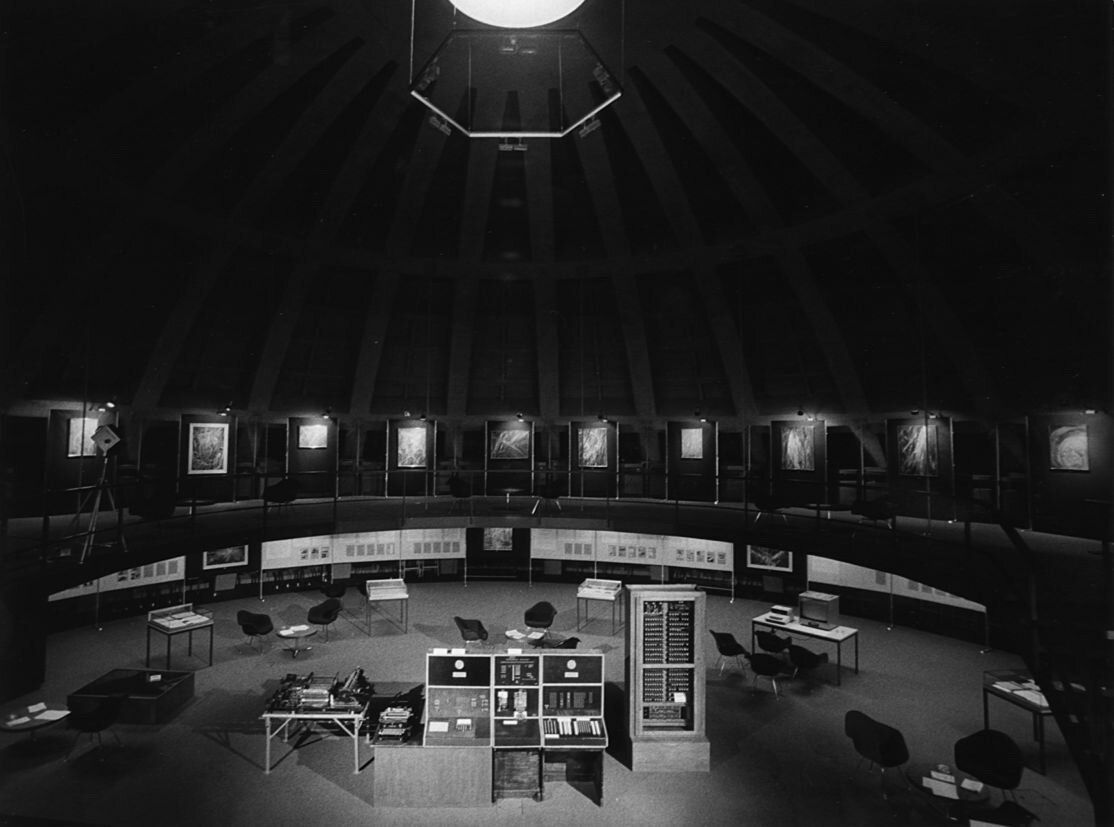
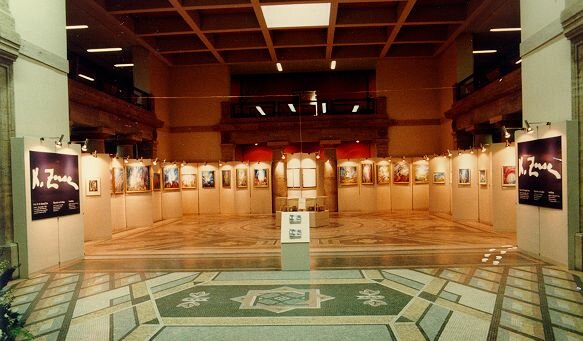
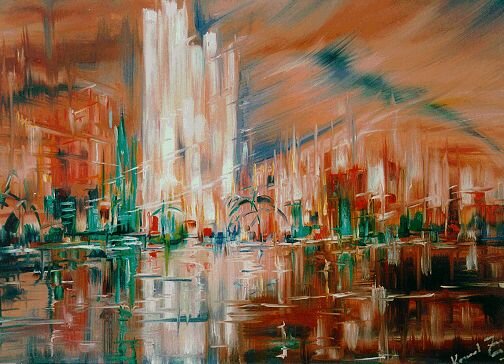
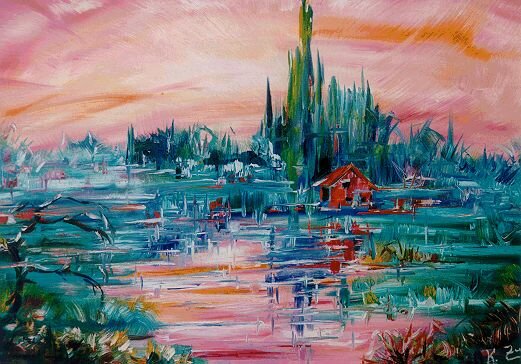
One of Konrad Zuse's major activities after 1964 (and especially after 1969) was painting. From 1964 to 1970 he used the pseudonym Kuno See in order to avoid any association with the Zuse KG. The following pictures show two major exhibitions of Konrad Zuse's oil paintings.