|
The Life and Work of Konrad Zuse (by Horst Zuse) |
| Part 7: The Zuse KG |
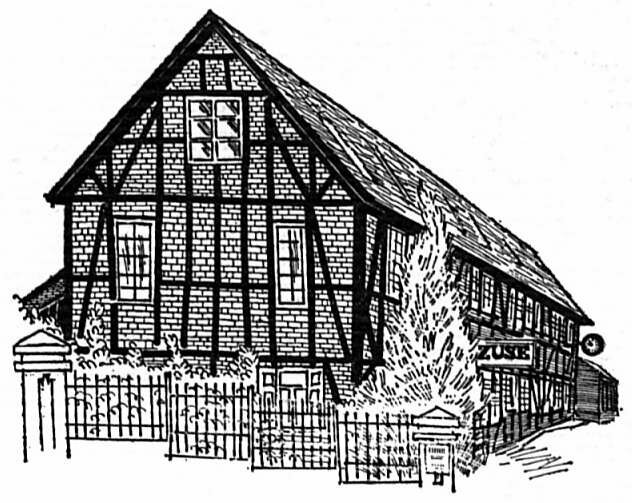
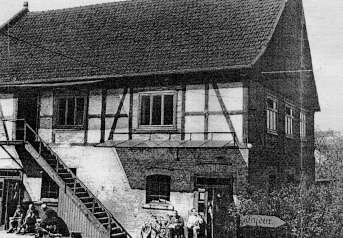
| In 1949 Konrad Zuse founded the Zuse KG with five employees in a small village of about 800 inhabitants called Neukirchen (Kreis Hünfeld, 120 km north of Frankfurt). (Note that "KG" means a special type of company in the form of a limited partnership. From 1949 to 1947 the partners were: Alfred Eckardt, Harro Stucken, and Konrad Zuse. From 1957 the partners were Konrad Zuse and his wife, and from 1964 onwards the Zuse KG had a number of owners as described later in this section.) The Zuse KG was the first computer company in Germany. The building used by the Zuse KG in Neukirchen was formerly a post relay station. | |
|
|
|
| Fig.63 (Left). A drawing of the Zuse KG in Neukirchen by Konrad Zuse in 1950. Fig.64 (Right). A photograph of the actual building.The Z4 computer was restored on the first floor close to the stairs. | |
| The first task of the Zuse KG in 1949 was to restore the Z4 for delivery to the ETH-Zürich. The Z4 was moved from Hopferau to Neukirchen (a journey of about 500 km) and was enhanced with the following features: | |
|
|
Implementing a conditional branch capability. |
 |
Adding instructions for printing the results on a Mercedes typewriter or a punch tape. |
 |
Storing numbers on the punch tape in order to transfer them into the Z4s memory. |
 |
Writing results on a punch tape. |
 |
Improving the facing of the machine, for example: adding sheathing for the relay cupboards. |
 |
Separating the service unit and the relay cupboards. |
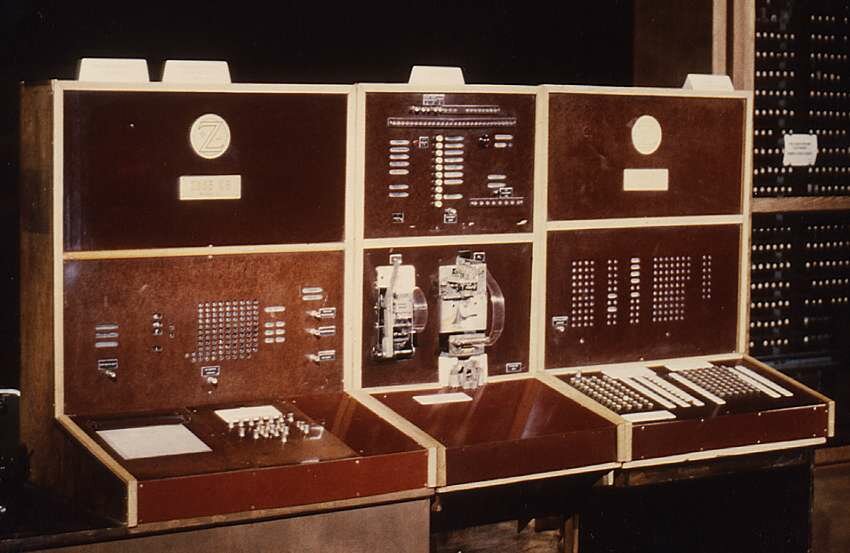
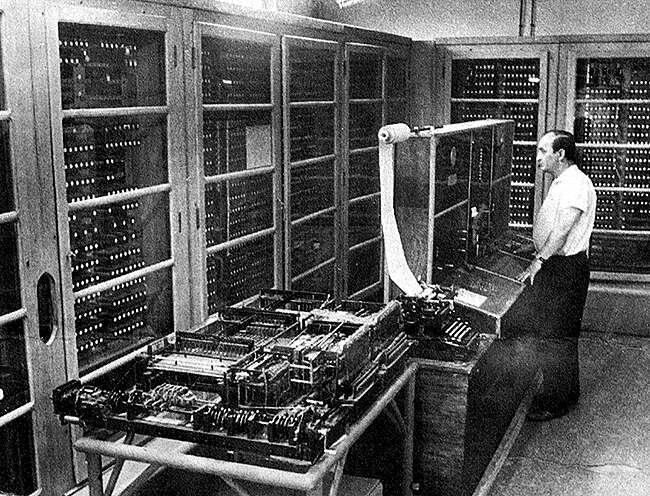
| The result of restoring the Z4 are shown in Fig.65 and Fig.66. | |
|
|
| Fig.65 (Left). The restored Z4 in Neukirchen in 1950. Fig.66 (Right).The Z4s console. On the left are the input and output devices for decimal floating point numbers, in the middle the punch tape readers and punch tape writer, and to the right is seen the Planfertigungsteil (program construction unit). | |
|
The Z4 was delivered to the ETH Zürich on July 11, 1950. This was a great day for the ETH and Switzerland as was noted by Speiser. Only half a year after the inauguration of the Z4 at the ETH, Rutishauser could report about the success of using the machine.
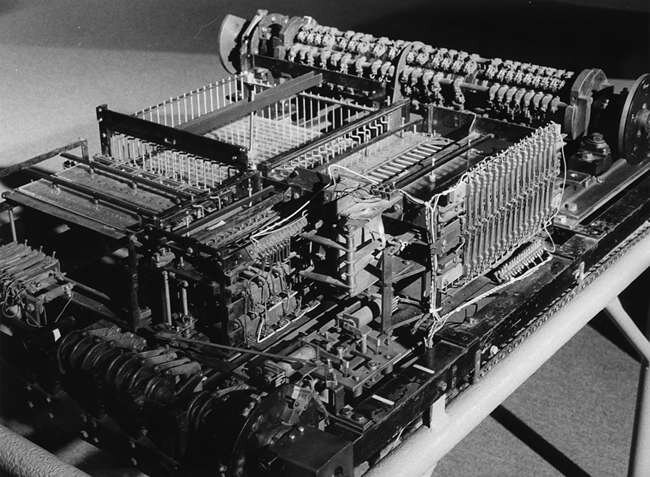
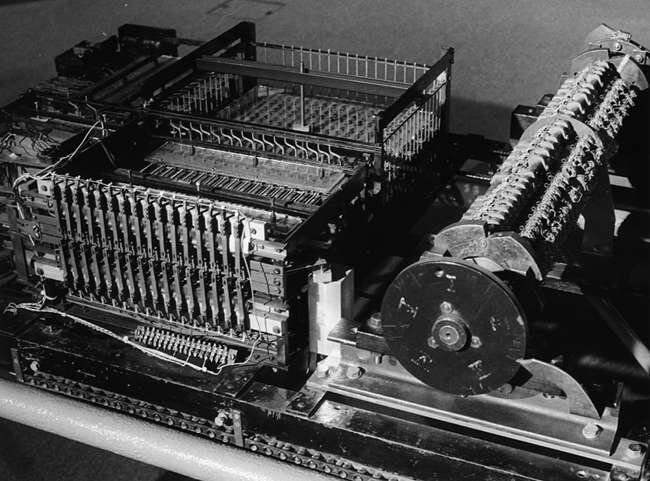
The restored Z4 consisted of about ten relay cupboards containing 2,200 standard relays, plus 21 stepwise relays for the micro-sequencer. The Z4s memory was a mechanical one with 64 words, each containing 32 bits. The structure of the mechanical memory was similar to the memory of the Z1. However, while the Z1 had a word length of 22 bits, the word length of the Z4 was extended to 32 bits. Each word was directly addressable by the instructions on the punch tape. This mechanical memory was a unique feature. In fact when the scientists from the ETH-Zürich saw this memory for the first time in 1948 in Hopferau, they reported to Professor Stiefel that they had never seen such an extraordinary construction before. They also reported to Prof. Stiefel, that they had doubts that this memory would ever work reliably. |
|
|
|
| Fig.67 (Left) and Fig.68 (Right). The Z4s memory consisting of thin metal sheets. This type of memory worked very reliably in the Z1 (1938) and Z2 (1939) machines. The capacity of the Z4s memory was 64 words, each containing 32 bits. | |
As Speiser [SPEI98] wrote about the operation of the Z4:
In fact the memory, consisting of thousands of metal sheets, screws and pins, was the most reliable feature of the Z4. The Z4 worked very reliably and also worked during the night without supervision. Speiser, who was responsible for the maintenance of the Z4 also wrote [SPEI98]:
|
|
 |
|
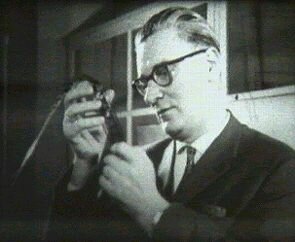
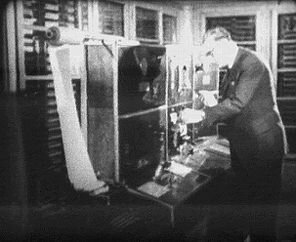
| Fig.69 (Left). Konrad Zuse working at the Z4 in Neukirchen (1950). Fig.70 (Right). Konrad Zuse considers one of the Z4s punch tapes. These punch tapes were what made Konrad Zuses computers freely programmable machines. | |
|
|
|
| Return to EPE Online Home Page | |