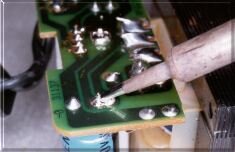
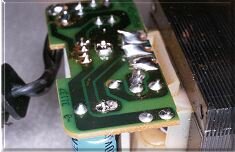
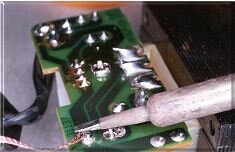
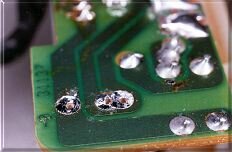
Welcome to the EPE Online
Desoldering Guide
Photo Gallery
|
Welcome to the EPE Online |
|
|
|
| De-soldering is required when electronic components need to be removed from a circuit, usually because they are faulty. It may sometimes be necessary during testing or assembly, if a wrong part has been fitted or a modification has to be made. In the field, it's not uncommon for faulty components to be swapped out, or poor joints (perhaps "dry" joints) to need re-making properly, months or years after manufacture. Experienced engineers can often diagnose a particular faulty joint immediately, because they may have seen the same problem on similar equipment before, especially if it has a "reputation". A proper desoldering technique can soon be acquired with practice - all you need to do is buy some scrap boards to have a go with, and desolder to your heart's content! The photo sequence below illustrates the basic steps for desoldering a printed circuit board, in order to remove a faulty part. Both a desoldering pump as well as desolder braid are illustrated. Some real-life examples of poor soldering are shown too, in my Black Museum of Bad Soldering! Remember that "Practice-makes-Perfect", and in the long run it costs less to get it right than it does to get it wrong! |
|
Enjoy! -- Alan Winstanley. |
|
|
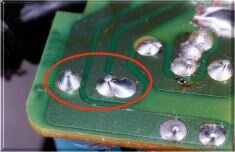 |
The two solder joints to be desoldered, to enable a faulty component to be removed. |
| If using a desoldering pump, apply the iron first to melt the solder (1-2 seconds). Ensure the pump is 'primed' and ready to go... |
|
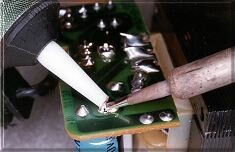 |
The nozzle of the desoldering pump is applied to the molten solder and the spring-loaded plunger is then released, drawing the solder up into the pump. Repeat if needed. |
| The first joint, now desoldered. The second joint will be desoldered using braid... |
|
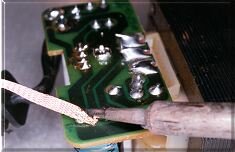 |
Select a suitable width of braid, and press it down onto the COLD joint using the hot tip of the iron. |
| Molten solder is drawn up by capillary action into the braid. Care not to overheat, or 'drag whiskers' of solder over the board, nor let the braid solidify on the joint! |
|
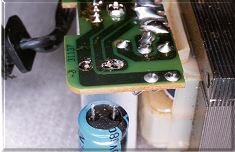 |
The component dropped out of the board after desoldering. Sometimes, it may need persuading with pliers.... |
| Close-up shot of both joints, now desoldered and ready for the replacement part to be fitted. |
|
|
|
|
The Black Museum of Bad Soldering |
| The following are all genuine examples of bad soldering which have not been retouched or reworked in any way. |
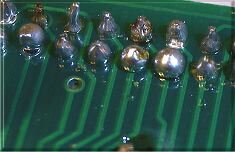 |
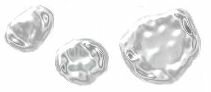
Tenfold excess of solder, and (extreme left) incomplete joint with poor coverage. There is no need to add more solder "for luck". |
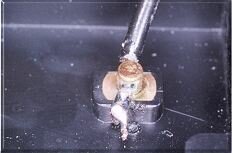
| One example of several dry joints found within a commercial PSU adaptor for a computer peripheral. | 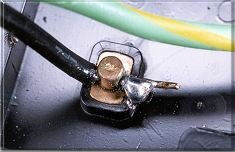 |
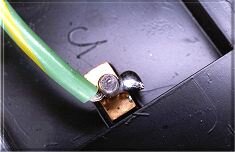 |
Hmmmm... this joint looks somewhat suspect as well... |
| A close-up reveals the terrible standard of soldering (and quality control), with a fracture visible on this ground/ earth joint. | 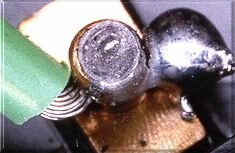 |
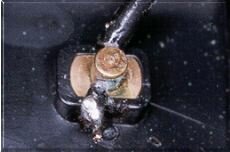 |
How not to make a mains voltage soldered joint. This went "dry" and starting arcing, nearly zapping the equipment. It is also a fire hazard. |
| The same mains connection, the wire merely being 'tacked on' with a blob of solder. |
|
| Copyright & Contact Info |
Return to the EPE Online home page. |