|
||
 |

EPE Hybrid Computer - Part 2
Approx construction cost US$352
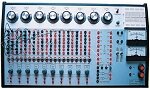
Last month the circuit technicalities for this design were discussed at length, and the initial constructional aspects were described. In this final part the remaining constructional details are presented, plus guidance on actually using the design to simulate real world engineering problems. Real-time computation of complex system behavior is greatly simplified by combining analogue and digital processing techniques Hybrid computers employ both major categories of electronic systems, the analogue and the digital. As is true with every type of system, each has its advantages and disadvantages. The hybrid system is an attempt to combine the best of both worlds. Many people imagine analogue computers to be antique units stored away in University laboratories. But not many people realize that in some cases the analogue computer can solve a problem with admirable elegance, ease and simplicity, while the solution of the same problem on the digital computer may be virtually impossible. A few analogue amplifiers connected together in a few minutes can give the solution to a complex problem with the units producing results in real time. A similar problem may take months to be programmed on the digital computer, provided the programmer has the skill to solve the equations. For the digital computer to execute the program, millions of iterations have to be performed, and not in real time. Granted digital computers are now very fast, but those tiny periods of time necessary to perform the iterations add up to considerable time periods. The EPE Hybrid Computer employs an ATOM digital microcontroller system, which operates in conjunction with the analogue system and can be programmed to control it. Moreover, it can be programmed to analyze and transmit information to a PC for the display of results or for further processing if required. Specification:
This project originally appeared in the November 2002 issue of EPEOnline. >> PURCHASE <<
|
|
Copyright © 1998-2004, TechBites Interactive Inc., All rights reserved. This site is powered by techbites. |
||