Rotary Combination Lock
Approx construction cost US$64
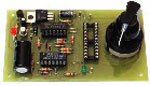
Pure logic and a "stack of cards" function help to maintain the security of your cherished possessions.
The purpose of this design is to emulate as closely and as simply as possible the traditional rotary combination lock. Full emulation would be possible with a complex design - close emulation is possible with a remarkably simple circuit - in this case using just two CMOS i.c.s and three transistors.
Pseudo-rotary combination locks are well known. These usually use a combined dial and pushbutton, with limited rotation of the dial. The dial is usually turned to a number in the sequence, then a pushbutton is pressed to register the number. Both this and the characteristics of the standard wafer rotary switch (its rotation-limit-stop and snap-action) make such locks seem poor substitutes for the real thing.
This design has smooth 360° rotation, does not use a pushbutton switch, and offers roughly twice the security of a 4-digit keypad lock. It also prevents aimless turning of the dial, and is able to send a secret panic (duress) signal to another location. The last two features are optional, and may be built onto an additional printed circuit board, which may also be interfaced to a standard intruder alarm system.
More details on this construction project can be found in the July 2002 issue of EPE Online, the world's first web-delivered electronics and computing hobbyist magazine.
PURCHASE this issue or peruse more Projects