|
||
 |

PIC-based Wind Tunnel
Approx construction cost US$72
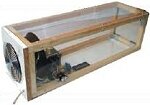
Scientifically investigate Nature’s second essential element. A wind tunnel can be used to investigate the effect of air flow on objects under controlled conditions, demonstrating, for example, how aircraft or bird wings create lift, or a vehicle’s shape affects its streamlining. In principle, a wind tunnel can be constructed using just a rolled tube of cardboard enclosing a fan, as the author did in the first instance. The sophistication, though, comes from adding rigidity to the construction and providing variable speed to the fan, plus a means of knowing at what rate the fan is moving air through the tunnel. This design is intended for use with the Wind Speed Meter project presented in the January ’03 issue, but can also be used on its own. It has an easily constructed long rectangular wooden frame with clear perspex panels that enclose a fan at one end whose rotation rate is controlled electronically by a potentiometer. Air flow rate is variable from less than 1 mph to around 8 mph, although the range can be raised or lowered depending on the motor used and the tunnel’s chosen dimensions. An optically coupled sensor responds to a light beam being broken by the fan blades and a PIC microcontroller determines the fan’s revolutions per second in relation to the number of fan blades. The result is shown on an alphanumeric liquid crystal display (LCD). The pulse rate detection circuit may be set to respond to fans having between one and nine blades.
This project originally appeared in the February 2003 issue of EPEOnline. >> PURCHASE <<
|
|
Copyright © 1998-2004, TechBites Interactive Inc., All rights reserved. This site is powered by techbites. |
||